You just got your blood test report. Everything looks like a wall of numbers. And then you spot it: HbA1c. A percentage. Maybe 6.1%. Maybe 7.4%. Maybe something higher.
And now you're wondering: is this bad? Should I be worried? What does this even mean?
This guide breaks it down completely. No medical jargon, no complicated explanations — just plain, simple language so you actually understand what your body is telling you.
What Is HbA1c, First of All?
Let's start from scratch.
HbA1c stands for Haemoglobin A1c. Haemoglobin (the Hb part) is a protein inside your red blood cells, and its job is to carry oxygen through your blood to every part of your body.
Here's the important bit: glucose (sugar, basically) in your blood naturally sticks to haemoglobin. The more sugar floating around in your blood day to day, the more of it gets attached.
Your HbA1c test measures exactly this: how much sugar has stuck to your haemoglobin over the past 2 to 3 months.
That's why doctors describe it as your 3-month average blood sugar. It's not a snapshot of today. It's a summary of how your body has been managing sugar over the last few months.
Think of it like this: if you check your weight every single morning, the number shifts based on what you ate yesterday. But if someone asks how your weight is overall, you'd give them an average. HbA1c is that average — for your blood sugar.
What the Percentages on Your Report Mean
Your HbA1c result shows up as a percentage. Here's what each range typically means:
| HbA1c Result | What It Means |
|---|---|
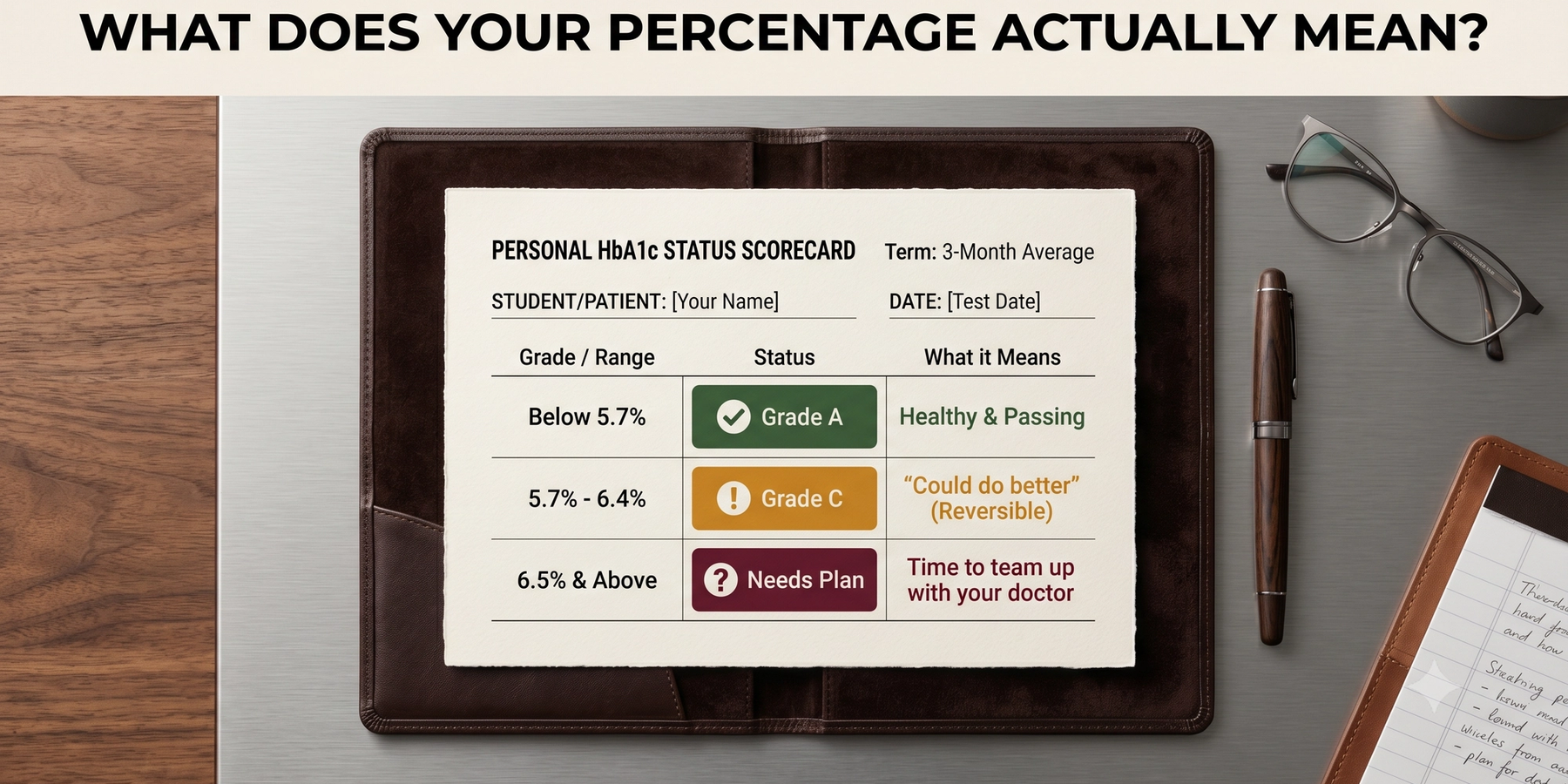
| Below 5.7% | Normal — a healthy average blood sugar |
| 5.7% to 6.4% | Pre-diabetes — higher than ideal, but reversible |
| 6.5% and above | Diabetes — diagnosed on two separate tests |
Below 5.7% — Normal
This is the range you want to be in. Your average blood sugar over the past few months has been healthy and your body is managing sugar the way it should. No action needed beyond keeping up your current lifestyle.
5.7% to 6.4% — Pre-diabetes
This is the watch-out zone. It doesn't mean you have diabetes. It means your blood sugar is slightly higher than it should be on average, and if nothing changes, there's a real risk it could move into the diabetes range over time.
The good news: this range is reversible. Diet, exercise, and small lifestyle changes at this stage can genuinely bring the number down. A lot of people catch this early and never progress further.
6.5% and Above — Diabetes
A reading of 6.5% or higher on two separate tests is how diabetes is typically diagnosed. This doesn't mean you're in a crisis. It means your blood sugar has been consistently higher than normal, and your doctor will want to put together a plan to manage it — which could include lifestyle changes, medication, or both.
A Simple Way to Picture It
Imagine a 3-month report card for your blood sugar. Below 5.7% is an A. Between 5.7% and 6.4% is a C — you're passing, but the teacher is saying you could do better. 6.5% and above means you're not passing yet, and you and the teacher need to work out a plan together.
The difference from an actual school report card is that this one is completely changeable based on your habits going forward.
What a 0.5% Change Actually Means
Here's something most people don't realise: a small shift in HbA1c, even half a percentage point, matters a lot.
Going from 7.5% to 7.0% might not sound like a big deal. But that change reflects weeks of consistently lower blood sugar. It reduces the strain on your kidneys, your eyes, your blood vessels, and your nerves.
In practical terms: if you've been eating differently, walking more, managing stress better, or your doctor has adjusted your medication, a 0.5% drop is a real sign that something is working. It's worth celebrating.
The reverse is also true. If your number went up by half a percent since your last test, it's worth a conversation with your doctor about what might have changed.
Percentage vs mmol/mol: Reading the Units
Some labs in India (especially those following international standards) show HbA1c in two units: the percentage you've just read about, and something called mmol/mol. You don't need to memorise both — here's a quick reference:
| HbA1c (%) | HbA1c (mmol/mol) | What It Indicates |
|---|---|---|
| 5.7% | 39 mmol/mol | Top of the normal range |
| 6.5% | 48 mmol/mol | Diabetes threshold |
As a rule of thumb, a number in the 40s or above in mmol/mol falls in the diabetes range, while something in the 30s is typically normal. If you're not sure which unit your report uses, check whether the number is followed by a percent sign or by mmol/mol — and if you're still unsure, ask your doctor which category your number falls into.
Does This Mean I Have Diabetes?
Not necessarily. An HbA1c of 6.5% or above suggests diabetes, but a single test result is usually not the final word. Your doctor will typically want to repeat the test, or run a few other tests alongside it, before confirming a diagnosis.
If your HbA1c came back elevated, the next step is a proper conversation with your doctor — not an internet spiral.
You Got Your Report and Your Doctor Isn't Free Right Now
This is something many people in India know well. Your report lands on WhatsApp. Your family doctor is at the clinic with 30 patients waiting. And you want to understand what you're holding before you walk in.
That's completely reasonable. Unlike in some countries where you might wait a week for an appointment, here you can usually see a neighbourhood doctor or general physician the same day or the next morning — you don't need to sit alone with a confusing report for five days.
But in those hours between getting your report and seeing your doctor, understanding your numbers — even at a basic level — makes a real difference. It helps you have a more informed conversation and ask real questions instead of just nodding along.
Questions to Ask Your Doctor About Your HbA1c
Whatever range your result falls in, here are some straight questions worth raising:
- If your result is below 5.7%: “How often should I get this tested, given my family history or diet?”
- If your result is 5.7%–6.4%: “What specific changes in my diet or activity would actually make a difference? How long before we test again to see if it's moved?”
- If your result is 6.5% or above: “What other tests do you want to run to confirm this? If it's confirmed, what would a treatment plan look like for me, and what HbA1c should I aim for?”
These questions put you in the driver's seat of your own health conversation.
When Medication Usually Comes Up
If your HbA1c is in the pre-diabetes range, lifestyle changes are almost always the first step. Doctors in India typically don't jump to medication here. Diet, walking, cutting back on refined carbohydrates (think maida, white rice, sugar), and managing stress are the tools used first.
If your HbA1c is in the diabetes range — particularly 7% or above — and lifestyle changes alone aren't bringing it down after a few months, your doctor may discuss medication. The most common first option is metformin, a tablet that helps your body use insulin more effectively. There are many other options now too, and the right one depends on your overall health picture.
The goal doctors usually aim for in someone with diabetes is an HbA1c below 7%, though this target can vary based on your age, other health conditions, and how long you've had diabetes.