Report comprehension calls are inbound contacts where a patient asks what something in their report means, rather than about scheduling, billing or collection. Most diagnostic centers never separate the two, so the volume is invisible in reporting even though it consumes real staff time. Once separated, roughly the majority of these calls turn out to be answerable without a clinician, which is what makes them reducible.
Ask a center owner how many calls they get about scheduling and they will tell you within ten percent. Ask how many they get from patients asking what a word in their report means, and you will usually get an estimate, a shrug, or a story about one particularly memorable Sunday.
That asymmetry is the whole problem. Scheduling calls are counted because they map to revenue. Report calls are absorbed. They arrive at the front desk, get partially answered, occasionally escalate to a technologist or the reporting radiologist, and leave no trace in any system. They are a direct symptom of the post-diagnostic communication gap, and unlike most symptoms of it, this one is measurable and reducible starting this month.
A taxonomy of the report call
Not all report calls are the same call, and treating them as one undifferentiated nuisance is why most centers conclude nothing can be done. In practice they fall into five recognisable types, and they differ sharply in whether a clinician is genuinely required.
1. Translation calls
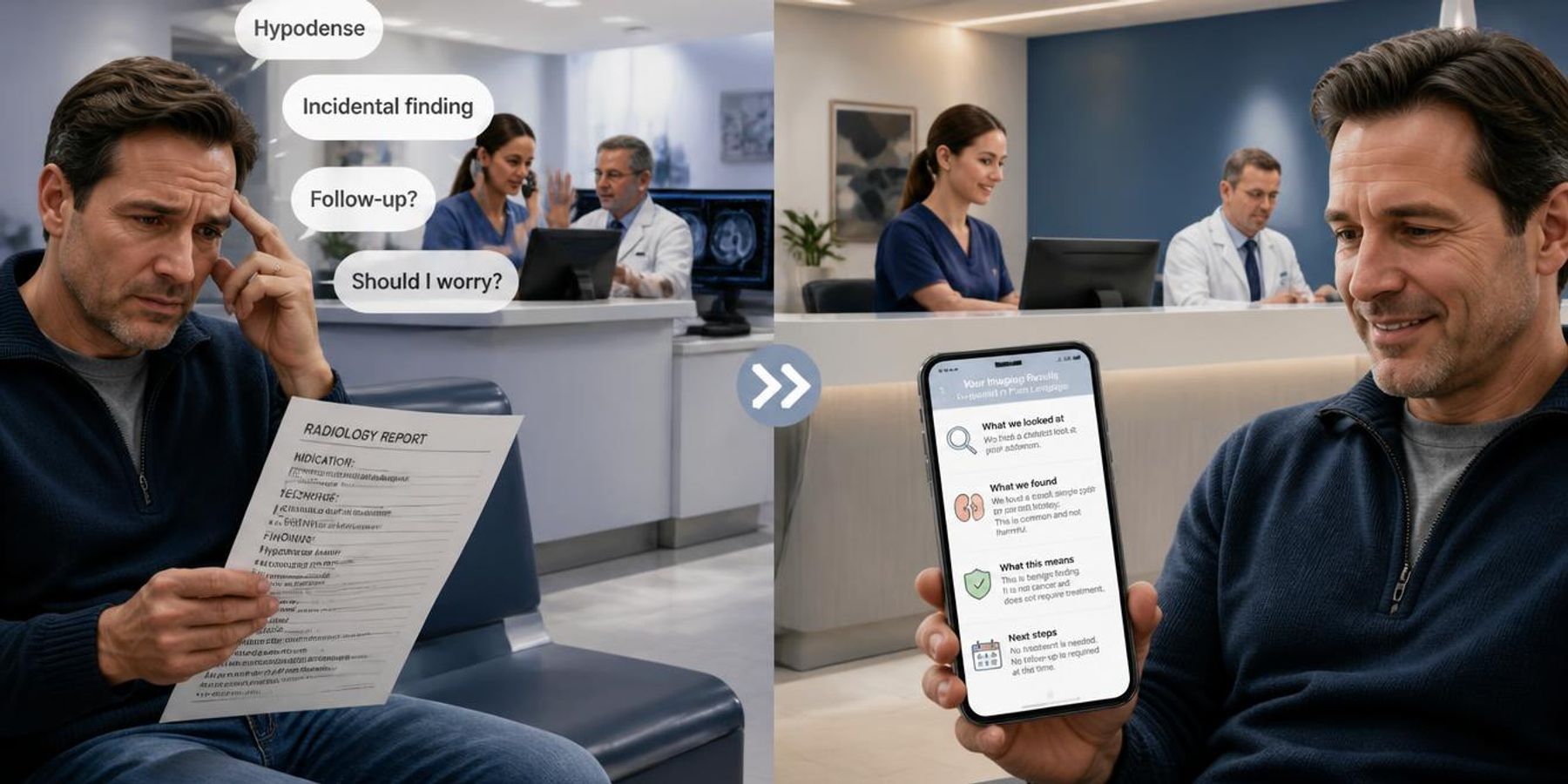
"What does hypodense mean?" "What is an incidental finding?" The patient is not asking for a clinical judgement. They are asking for a definition, because the report used vocabulary written for a physician. This is the single largest category at most centers and requires no clinical input whatsoever.
2. Urgency calls
"Should I be worried?" "Do I need to see someone today?" The patient is trying to work out whether their finding needs immediate attention. These calls feel like translation calls but are not. They carry genuine clinical weight and must be handled accordingly. More on this below, because getting this category wrong is the main way centers create risk while trying to save time.
3. Navigation calls
"Who do I show this to?" "Do I go back to the doctor who referred me, or a specialist?" "Do I need another test?" This is a process question wearing clinical clothing. The patient is lost in a pathway your organisation understands and they do not.
4. Comparison calls
"Is this better or worse than last time?" Common in follow-up and chronic-condition patients. The patient is holding two reports and cannot tell whether the wording signals change or stability. Phrases like no significant interval change are precise to a radiologist and meaningless to everyone else.
5. Genuinely clinical calls
"What is going to happen to me?" "What are my options?" These require a clinician, always. They are also the smallest category by volume, and the one your staff currently has the least time for, precisely because the other four are consuming the day.
| Call type | What they are actually asking | Needs a clinician? | Where it should be resolved |
|---|---|---|---|
| Translation | Define this word | No | At the point of report delivery, before the call happens |
| Urgency | Is this an emergency? | Yes, for the judgement | Clear escalation path to a clinician, with no filtering by non-clinical staff |
| Navigation | What do I do next, and with whom? | No | Standard pathway guidance issued with the report |
| Comparison | Has this changed since last time? | Sometimes | Plain-language framing of change wording, escalate if unclear |
| Genuinely clinical | What does this mean for me? | Yes | The consultation, protected by removing the other four |
Run this taxonomy against a week of your own calls and the distribution is usually a surprise. Translation and navigation together tend to dominate, and neither requires the expensive people they currently reach.
Most report calls are not clinical questions. They are vocabulary questions being asked of clinical staff, because nobody else was available to answer them.
Why the volume grows faster than your scan volume
Centers tend to assume report calls scale linearly with scans. They do not. Three things compound them. Digital delivery means every patient now receives the report directly rather than through a referring clinician, so the population able to call you has expanded. Faster turnaround means patients receive results earlier relative to their appointment, lengthening the window in which questions form. And follow-up patients generate comparison calls that first-time patients do not, so a maturing patient base raises the per-scan call rate on its own.
In the US this shift was accelerated by regulation, since immediate release put results in patients' hands by default. In India the same effect arrived through WhatsApp and app-based delivery. Either way, the addressable population for a report call is now every patient you scan.
What it costs: run your own numbers
Be sceptical of any vendor quoting an industry-average cost for this, including us. The number that matters is yours, and four inputs produce it:
- Report comprehension contacts per month, tagged separately from scheduling and billing.
- Average handling time, including hold time and the minutes lost when a call is escalated and someone has to open the study.
- Escalation rate: what share reach a technologist or radiologist, and the fully loaded cost of those minutes rather than front-desk minutes.
- Displacement: what your front desk was not doing while on those calls. This is usually where the real cost sits, because the alternative activity is often booking.
The before-and-after workflow
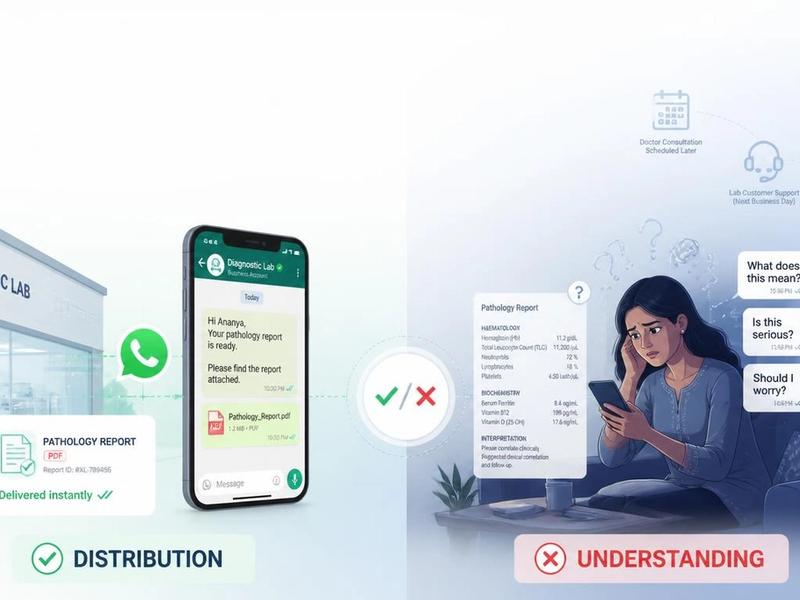
The current workflow at most centers is not a workflow. The report is delivered as a bare PDF with no accompanying context. The patient opens it, encounters unfamiliar language, and the only route to clarification is your phone number. Every question, regardless of type, arrives through the same channel and is triaged by whoever picks up.
A designed workflow does three things differently. It answers translation and navigation questions at the moment of delivery, before they become calls, by sending a plain-language explanation and clear next-step guidance alongside the report. It gives urgency questions their own explicit, fast route to a clinician rather than burying them in the general queue. And it leaves the genuinely clinical questions for the consultation, which now has time for them.
Note what is not being proposed. Nothing here withholds a report, delays a result, or places a non-clinician between a patient and clinical judgement. The report is unchanged and released exactly as before. What changes is what travels with it.
What must never be automated
This is the part most vendors skip, so it is worth stating plainly. Urgency determination is a clinical act. Any system, ours included, that appears to tell a patient whether their finding is serious has crossed from communication into clinical decision-making, and should be rejected on that basis.
A 30-day plan
- Week 1: add the "report question" tag to your front-desk log. Brief the team that they are counting, not changing anything yet.
- Week 2: classify a sample of those calls against the five types. Twenty calls is enough to see the shape.
- Week 3: fix navigation first. It is the easiest win and needs no technology, only a standard next-steps message issued with every report.
- Week 3: define your urgency escalation path explicitly, in writing, and make sure the front desk knows it is a route rather than a judgement they are expected to make.
- Week 4: address translation, the largest category. This is where an explanation layer earns its place, because the volume is high, the clinical risk is low, and the work is entirely repeatable.
Halving the volume is a realistic target for most centers, because translation and navigation together usually account for more than half of it, and neither needed a clinician in the first place.