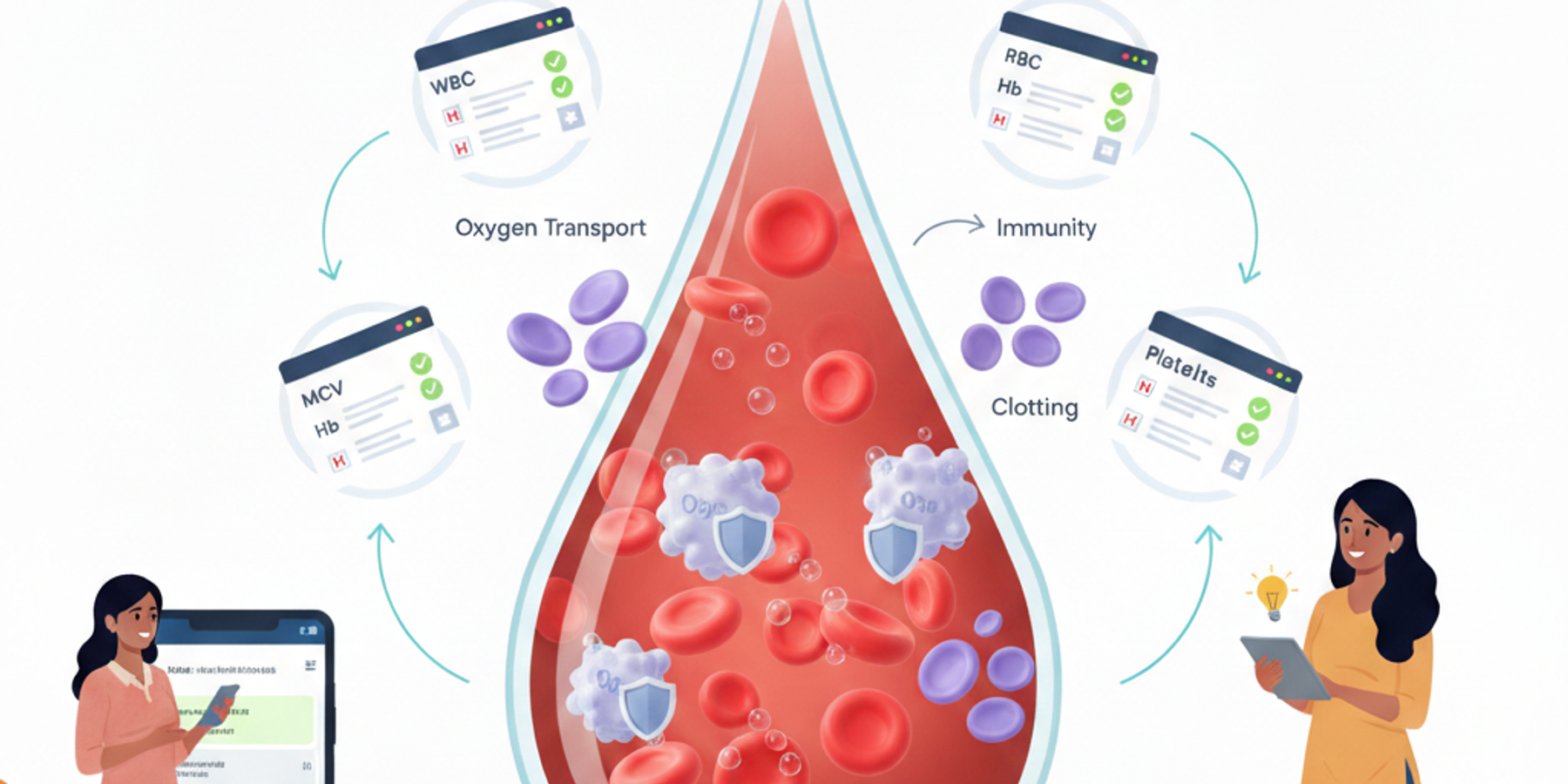
A CBC or Complete Blood Count is one of the most common blood tests ordered in India, and most people receive it before they have a chance to speak to their doctor. The report measures three main things: red blood cells which carry oxygen, white blood cells which fight infection, and platelets which control bleeding. Key values like haemoglobin, MCV, and MCH help identify common conditions like iron deficiency anaemia and Vitamin B12 deficiency, both of which are extremely common in India. Rather than reading each number in isolation, doctors look for patterns across the report, and understanding those patterns helps you walk into your doctor's appointment with the right questions instead of blind anxiety. Most flagged values in a CBC are not emergencies, but a few specific combinations do need same-day attention. Knowing the difference is what this guide is for.
You just picked up your blood test report from the lab counter, or maybe it came on WhatsApp from Dr. Lal PathLabs or SRL. You open it and see a table full of short forms like WBC, RBC, MCV, MCH. Next to some of them, there's an arrow pointing up or a small "H" or "L" printed in red.
And you have no idea what any of it means.
That's completely normal. These reports are written for doctors, not for the person whose blood was actually tested. The abbreviations, the reference ranges on the side, the way the numbers are formatted, all of it assumes a doctor is reading it.
But you got it first. And you want to understand it before you walk into that clinic.
This guide goes through every part of a CBC report in plain language. What each thing measures. What it means when a value is high or low. And what to say to your doctor when you sit down with them.
What Is a CBC Test and Why Is It Done?
CBC stands for Complete Blood Count. It's one of the most common blood tests done in India. Almost every doctor orders it at some point, whether you came in with fatigue, fever, body pain, or just for a routine check before a surgery.
What it does is simple. It counts the three main types of cells that travel in your blood:
- Red blood cells — these carry oxygen from your lungs to the rest of your body
- White blood cells — these fight infections and protect you from disease
- Platelets — these are what stop you from bleeding when you get a cut
The test itself takes a few minutes. A small amount of blood is taken from your arm. Most Indian labs return results within a few hours, sometimes the same morning.
The confusing part is reading the report. So let's go through it, section by section.
WBC — White Blood Cell Count
What is a white blood cell?
Think of white blood cells as your body's security guards. They patrol your blood and tissues, and the moment they detect something foreign, like a bacteria or virus, they rush in to fight it. When your body is dealing with an infection, it produces more of these cells to handle the threat.
What does the number mean?
Your CBC report will show a WBC count, usually expressed as the number of cells in one microlitre of blood. The normal range for most adults is between 4,000 and 11,000 cells per microlitre. Your report might write this as 4.0 to 11.0, with a unit next to it.
If the number is high
A high WBC count almost always means your body is fighting something. The most common reasons are a bacterial or viral infection, some kind of internal inflammation, or physical stress on the body. It can also go up temporarily after a steroid injection.
A mildly high count is common and usually not alarming on its own. What matters is whether it's accompanied by symptoms like fever, pain, or swelling.
If the number is low
A low WBC count means your immune system is under pressure. In India, infections like dengue and typhoid are well known for dropping WBC counts significantly. Certain medications can also bring it down.
What to tell your doctor
If your WBC is flagged, tell your doctor if you've had fever, unusual fatigue, a recent infection, or any change in medication in the past two to three weeks. That context helps them understand the number.
RBC — Red Blood Cell Count
What is a red blood cell?
Red blood cells are like delivery vehicles. Their only job is to carry oxygen from your lungs to every organ, muscle, and tissue in your body. Without enough of them, your body doesn't get the oxygen it needs to function well.
What does the number mean?
Your report will show the total count of red blood cells per microlitre of blood. Normal ranges are:
- Men: 4.5 to 5.9 million cells per microlitre
- Women: 4.0 to 5.2 million cells per microlitre
Women naturally have a slightly lower count than men, which is normal.
If the number is high
A high RBC count usually means your body is trying to compensate for not getting enough oxygen. This can happen if you smoke heavily, live at a high altitude, or have a condition that affects your lungs. It's less common than a low count.
If the number is low
A low RBC count means your blood isn't delivering enough oxygen around your body. This is what's usually called anaemia, a word you've probably heard before. The symptoms feel like constant fatigue, weakness, shortness of breath when you climb stairs, and sometimes a pale look to your face or the inside of your lower eyelids.
In India, a low RBC count, particularly in women, is extremely common and is often the reason behind months of feeling exhausted without a clear explanation.
Haemoglobin
What is haemoglobin?
Haemoglobin is a protein that lives inside red blood cells. It's what actually carries the oxygen. So your RBC count tells you how many red blood cells you have, and your haemoglobin level tells you how well each of those cells is doing its job.
You can have enough red blood cells but still have low haemoglobin if those cells aren't carrying enough oxygen. This is why both numbers matter.
What does the number mean?
Haemoglobin is measured in grams per decilitre (g/dL). Normal ranges are:
- Men: 13.5 to 17.5 g/dL
- Women: 12.0 to 15.5 g/dL
If it's low
Low haemoglobin is one of the most common findings in blood reports across India. It means your blood isn't carrying enough oxygen, which leads to that familiar tired, drained, heavy feeling. Many people live with slightly low haemoglobin for years without realising it's the cause of their fatigue.
The most common reason in India is iron deficiency, often linked to diet, heavy periods in women, or both. Another surprisingly common reason, especially in vegetarians, is Vitamin B12 deficiency. B12 is found almost entirely in animal products, and vegetarians who don't supplement it often end up with low haemoglobin over time.
If it's high
High haemoglobin is less common. It can be caused by dehydration, meaning your blood is more concentrated than usual, or by long-term smoking. In rare cases it points to a blood condition, but your doctor will check for that.
What to tell your doctor
If your haemoglobin is flagged low, share details about your daily diet, whether you eat meat or not, and if you're a woman, details about your menstrual cycle. These three things together help your doctor figure out the cause quickly.
Haematocrit (PCV)
What is haematocrit?
Haematocrit, also called PCV or Packed Cell Volume, answers a simple question: out of all the liquid in your blood, what percentage is made up of actual red blood cells?
Think of it like this. If you fill a glass with your blood and let it settle, haematocrit tells you how much of that glass is solid red cells versus liquid.
What does the number mean?
It's expressed as a percentage. Normal ranges are:
- Men: 41% to 53%
- Women: 36% to 46%
You'll notice this number closely follows your haemoglobin value. If haemoglobin is low, haematocrit is usually low too. They tell the same story from two slightly different angles. When both are flagged together, it actually gives your doctor a clearer picture rather than a confusing one.
Platelets
What are platelets?
Platelets are tiny, disc-shaped cells that have one very specific job: stopping bleeding. When you cut yourself, platelets rush to the site and clump together to form a clot, like a temporary patch over the wound. Without enough platelets, even a small cut takes much longer to stop bleeding.
What does the number mean?
Platelet count is measured in lakhs per microlitre of blood in most Indian lab reports. The normal range is 1.5 lakh to 4.5 lakh per microlitre. Some reports write this as 150,000 to 450,000.
If the count is high
A high platelet count can be a response to infection, iron deficiency, or inflammation in the body. In most cases it's temporary and settles on its own once the underlying issue is treated.
If the count is low
In India, the moment someone sees a low platelet count during a fever, the first thought is dengue. And that's a fair instinct. Dengue is one of the most common reasons platelets drop during a fever in India, especially during monsoon season. Typhoid and other viral infections can cause this too.
Here's how to think about the numbers:
- Below 1 lakh: your doctor will want to monitor this closely
- Below 50,000: any procedure or surgery becomes risky, and your doctor will be more cautious
- Below 20,000: this is a significant drop and needs same-day medical attention
But here's what's important to know: if you have a fever and your platelets have dropped but are still above 80,000, most doctors in India will ask you to repeat the test the next day to watch the trend rather than panic immediately.
MCV, MCH, MCHC — The Smaller Parameters
These three values appear near the bottom of most CBC reports. Many people skip them because the names look complicated. But they're actually quite useful, and understanding them helps explain why your haemoglobin is low in the first place.
MCV — Mean Corpuscular Volume
This tells you the average size of your red blood cells. That's it. Are your red blood cells the right size, too small, or too large?
Normal range: 80 to 100 fL (femtolitres, which is just the unit used to measure very tiny volumes)
If MCV is low (small red blood cells): This usually means iron deficiency anaemia. Small cells are a classic sign that your body doesn't have enough iron to build properly sized red blood cells. In some communities in India, particularly in Gujarat, Maharashtra, and parts of South India, small red blood cells can also point to a genetic condition called thalassemia trait, which many people carry without knowing it.
If MCV is high (large red blood cells): This points toward a deficiency of Vitamin B12 or folate (Vitamin B9). Your bone marrow is producing oversized cells because it doesn't have the right nutrients to finish the job properly. This is worth noting for vegetarians and vegans who often don't get enough B12 from food alone.
MCH — Mean Corpuscular Haemoglobin
If MCV tells you the size of your red blood cells, MCH tells you how much haemoglobin is packed inside each one. A small cell usually holds less haemoglobin. A large cell often holds more.
Normal range: 27 to 33 pg (picograms, another tiny unit of measurement)
Low MCH usually appears alongside low MCV and confirms iron deficiency. High MCH usually appears with high MCV and confirms B12 or folate issues. They tell the same story together.
MCHC — Mean Corpuscular Haemoglobin Concentration
This one goes one step further. It measures the concentration of haemoglobin in the red blood cells, meaning how packed in it is relative to the cell's size.
Normal range: 32 to 36 g/dL
This value rarely shows a critical flag on its own. It mainly helps your doctor confirm the pattern they're already seeing from MCV and MCH. You don't need to worry too much about this one independently.
Common Patterns in CBC Reports
Doctors don't look at each number in isolation. They look for patterns across the whole report. Here are four common ones you might recognise in your own results:
Pattern 1: Low Hb + Low MCV + Low MCH This is the classic iron deficiency picture. Very common across India, especially in women and young children. Your doctor will likely start with iron supplements and may order a separate ferritin test (which measures your body's iron stores) to confirm.
Pattern 2: Low Hb + High MCV Your haemoglobin is low, but your red blood cells are actually larger than normal. This points toward Vitamin B12 or folate deficiency. Common in vegetarians who don't supplement. Easy to treat once confirmed with a simple B12 blood test.
Pattern 3: Low WBC + Low Platelets with Fever Both your infection-fighters and your clotting cells are dropping at the same time, and you have a fever. In India, this pattern during monsoon season is dengue until proven otherwise. Your doctor will test for it specifically.
Pattern 4: High WBC with Fever Your body is producing extra infection-fighting cells because it's dealing with something. This is a signal of active infection. The type of infection, bacterial or viral, can often be narrowed down by looking at which subtype of WBC is elevated. Your doctor will explain this.
Questions to Ask Your Doctor After Getting a CBC Report
Here's something worth knowing about getting medical care in India: you don't have to wait five days for an appointment. You can walk into a neighbourhood clinic or call your family doctor within a few hours. That's genuinely an advantage. Use it.
But when you get there, make the conversation count. Here are questions worth having ready:
- Which values in my report are actually abnormal for my age and situation, and which ones are minor variations I shouldn't worry about?
- Do these numbers together suggest a particular pattern, like iron deficiency or an infection?
- If I have anaemia, what's the likely cause? Do I need more tests to confirm it?
- Should I repeat this test, and if yes, after how many days?
- Is there anything in this report that needs treatment right now, or can we wait and monitor?
- Does anything here suggest I should see a specialist?
Most good doctors will walk you through the key findings anyway. But coming in with these questions means you leave the appointment with a clear next step, not a vague "take rest and we'll see."
When Should You Actually Be Concerned?
Most flags on a CBC report are not emergencies. A mildly low haemoglobin, a slightly elevated WBC, a platelet count that's nudged above the range, these are all worth a conversation with your doctor but not worth losing sleep over.
There are a few specific situations, though, where you should see a doctor the same day rather than wait:
- Haemoglobin below 7 g/dL, especially if you're feeling breathless even while resting
- Platelet count below 50,000, particularly if you notice tiny red or purple spots on your skin that look like a rash, or if you have any unexplained bleeding
- WBC above 30,000 with no obvious known cause
- All three values (WBC, RBC, and platelets) are low at the same time, which is a pattern that needs prompt evaluation
If your report shows any of these and you have symptoms that concern you, don't sit on it. Walk into the nearest clinic.
For everything else, you have time to understand what you're looking at, ask the right questions, and have a calm, informed conversation with your doctor.
Still Confused About Something Specific in Your Report?
A general guide like this one explains the typical meaning of each value. But your report has specific numbers, specific combinations of flags, and a specific context that a general article cannot fully speak to.
FlexReport's Engine reads your actual report and breaks it down in plain language, specific to what was found in your test. You get a clear explanation of what each flagged value means for you, and a short list of questions to bring to your doctor.
Upload your CBC report. Understand it before your next appointment.
Frequently Asked Questions
Can a CBC report tell me if I have a serious disease?
A CBC gives your doctor important clues but rarely a definitive diagnosis on its own. A flag on your report is a starting point, not a verdict. Your doctor will use it alongside your symptoms and other tests to reach a conclusion.
My haemoglobin is slightly low but I feel perfectly fine. Should I still see a doctor?
Yes. Anaemia builds gradually and many people feel normal even with a low count. A quick visit to your doctor will tell you if you need iron or B12 supplements. It's usually a simple fix once identified.
Is a CBC the same as a lipid profile or liver function test?
No. A CBC counts your blood cells. A lipid profile measures cholesterol levels. A liver function test checks how your liver is working. Many health packages include all three, which is why people sometimes see them together on the same report.
How long does a CBC report take to come back?
Most Indian labs return CBC results within 4 to 6 hours. Many same-day labs deliver reports by evening if blood is drawn in the morning. Some centres send results on WhatsApp within 2 to 3 hours.
Do I need to be fasting before a CBC test?
No. A CBC does not require fasting. You can eat and drink normally before the test. Fasting is needed for other tests like blood sugar or a lipid profile, not for a blood count.
What does it mean if multiple values are flagged in my CBC report?
Multiple flags together usually tell a more specific story than a single flag. For example, low haemoglobin with low MCV and low MCH together almost always points to iron deficiency. Your doctor reads the pattern, not just individual numbers. One or two mild flags on their own are rarely cause for concern.
Can stress or lack of sleep affect my CBC results?
Yes, to a degree. Acute physical stress, heavy exercise, or severe sleep deprivation can temporarily shift WBC counts. But these effects are usually minor. If your doctor suspects a lifestyle factor is skewing the result, they may ask you to repeat the test under normal conditions.
A general guide explains what CBC values typically mean. But your report has specific numbers, specific flags, and a specific combination that only speaks to your situation.
FlexReport's Engine reads your actual CBC report and breaks it down in plain language. You get a clear explanation of every flagged value, what it likely means, and a short list of questions to bring to your doctor so you walk in informed, not anxious.