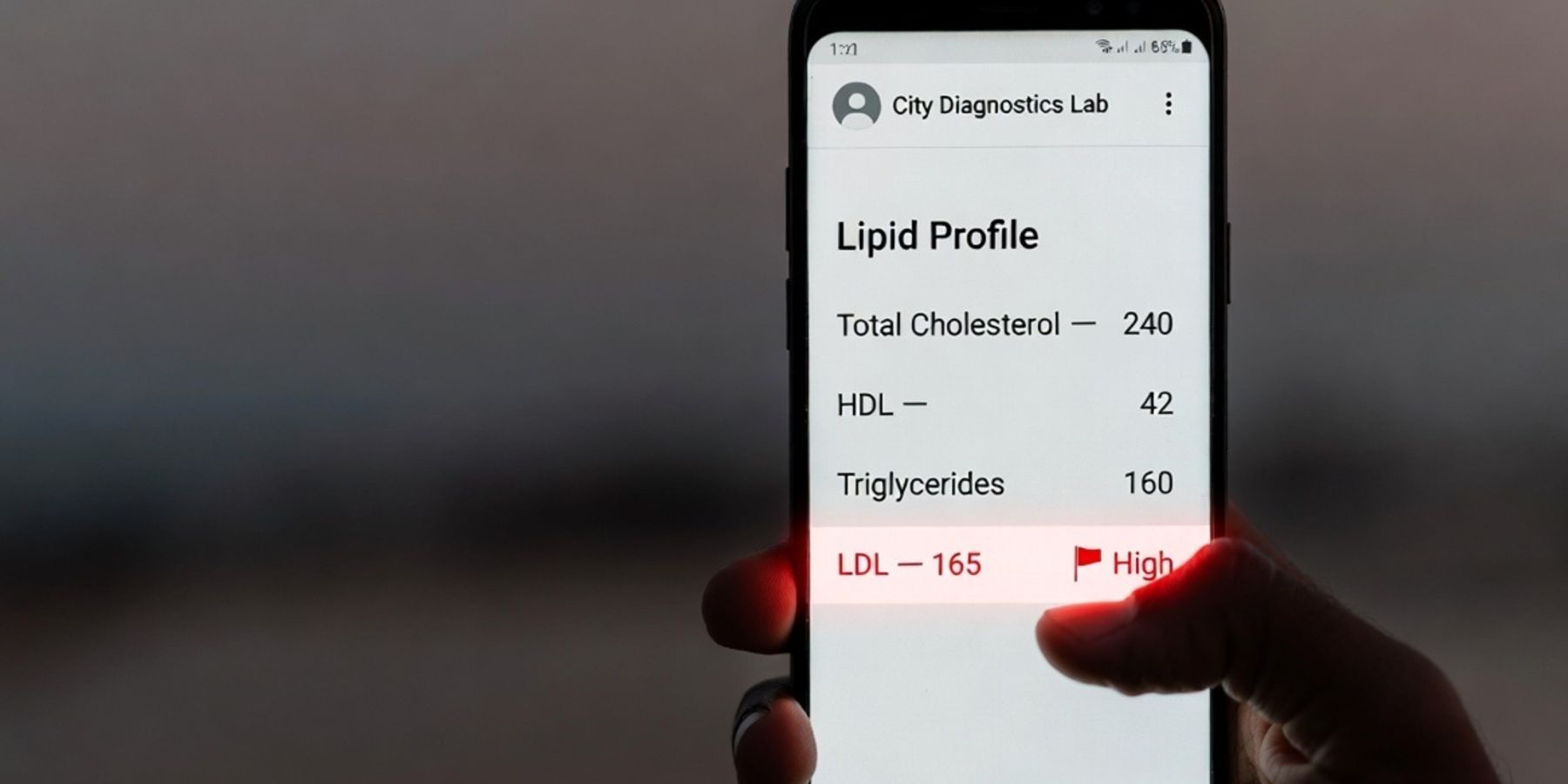
You got your lipid profile report on WhatsApp from the lab, opened it on your phone in the middle of something else, and one line was sitting there in red: LDL 165, High. And just like that, your evening changed.
Here is the short version of what your lipid profile results mean before we go deeper: a lipid profile is a blood test that measures the fats floating in your blood. The four numbers that matter most are total cholesterol, LDL, HDL and triglycerides. A number in red is not a diagnosis. It is one data point that tells your doctor where to look. By the end of this guide you will understand each number, know what is actually high and what is fine, and walk into your doctor with the right questions instead of a knot in your stomach.
What a lipid profile is actually measuring
Your body needs some fat in the blood to function. The problem is too much of the wrong kind, sitting around for too long. A lipid profile (lipid simply means fat) is the blood test that measures these fats. You may also see it called a lipid panel or a cholesterol test. They are the same thing.
Cholesterol is a soft, waxy fat your body makes on its own and also gets from food. It does not dissolve in blood, so it travels around wrapped inside tiny carrier packages made of protein. Those carriers are what LDL and HDL actually are. Keep that picture in mind, because once you understand the carriers, the whole report stops feeling like code.
Most Indian labs report these numbers in mg/dL, which stands for milligrams per decilitre. It is just a way of saying how much of something is packed into a fixed amount of blood. You do not need to do any maths with it. You only need to know whether your number sits in the comfortable range or the watch-it range.
Here are the four main numbers, in one glance:
| Marker | Full form | What it does, in plain terms | Comfortable range |
|---|---|---|---|
| Total cholesterol | (no short form) | All the cholesterol in your blood added up | Below 200 mg/dL |
| LDL | Low-Density Lipoprotein | The carrier that drops cholesterol into artery walls (the "bad" one) | Below 100 mg/dL |
| HDL | High-Density Lipoprotein | The carrier that picks cholesterol back up and clears it (the "good" one) | 40+ for men, 50+ for women |
| Triglycerides | (no short form) | Stored fat from food and from your liver | Below 150 mg/dL |
A quick word on the test itself. Many labs ask you to fast for 9 to 12 hours before the blood draw, which is why people do it first thing in the morning. The lipid panel measures total cholesterol, LDL, HDL and triglycerides, and the values are reported in milligrams per decilitre. If you ate before the test and the triglyceride number looks oddly high, that could simply be last night's dinner talking. Worth mentioning to your doctor.
Total cholesterol: the headline number that means less than you think
Total cholesterol is the number everyone fixates on, and it is the one that tells you the least on its own. That sounds backwards, so here is why.
Total cholesterol is basically your LDL, your HDL and a slice of your triglycerides all added together into a single figure. A desirable total cholesterol is below 200 mg/dL. The usual labels you will see are:
| Total cholesterol | What it means |
|---|---|
| Below 200 | Desirable |
| 200 to 239 | Borderline high |
| 240 and above | High |
But think about what the addition hides. If your total is 230 because your good HDL is high, that is a very different situation from a total of 230 driven by bad LDL. Same headline, opposite stories. This is why doctors compare your total cholesterol against your HDL to get a clearer picture, rather than reading the total alone. So if your total is a little high, do not panic at the headline. Scroll down to the breakdown. That is where the real meaning lives.
This is the cholesterol report interpretation trap most people fall into. They read line one, feel scared, and never read the lines that explain it.
LDL cholesterol high meaning: the one everyone worries about
LDL stands for Low-Density Lipoprotein. This is the carrier that tends to drop cholesterol off along the inner walls of your arteries. Over years, those deposits can build up and narrow the pipe, which is why LDL has the bad cholesterol reputation. LDL is the cholesterol most strongly linked to clogged arteries and heart risk, which is why it gets the most attention. When your report flags LDL as high, that is the line your doctor will care about most.
Here is how labs usually band the LDL number:
| Your LDL number | Usual label |
|---|---|
| Below 100 | Optimal |
| 100 to 129 | Near optimal |
| 130 to 159 | Borderline high |
| 160 to 189 | High |
| 190 and above | Very high |
Now the part most articles skip, and the part that actually matters. There is no single LDL target for everyone. The good number depends on your heart history. A 25-year-old with no risk factors and a 60-year-old who already had a heart attack are held to completely different standards, because the second person's arteries cannot afford the same level of LDL.
The latest cholesterol guidelines, updated in 2026, lay this out in tiers:
| Your situation | LDL goal doctors usually aim for |
|---|---|
| No heart disease, low to moderate risk | Below 100 mg/dL |
| High risk (diabetes, strong family history, several risk factors together) | Below 70 mg/dL |
| Already had a heart attack or stroke, or known heart disease | Below 55 mg/dL |
Under the 2026 ACC/AHA guidelines, the LDL goal is below 100 for those at borderline or intermediate risk, below 70 for high risk, and below 55 for people with established cardiovascular disease who are at very high risk. The logic is simple once you hear it: the higher your risk, the lower you want to push the bad carrier. So an LDL of 110 might be perfectly acceptable for one person and something to actively bring down for another.
Your number means nothing without your story attached to it.
HDL cholesterol low meaning: the number you want to be higher
HDL stands for High-Density Lipoprotein. This is the helpful carrier. It does the opposite job of LDL: it picks up loose cholesterol and carries it back to the liver to be cleared out. Think of it as the cleanup crew for your arteries.
Because it is the good one, HDL is the only number on the whole report where higher is better. So when a report flags HDL as low, that low is a small concern, not a relief. HDL should ideally not fall below 40 mg/dL in men or 50 mg/dL in women, and a level around 60 or above is considered protective.
So the HDL cholesterol low meaning is straightforward: you have less of the cleanup crew than you would like. It often travels in bad company too. When triglycerides are high, HDL is frequently low and LDL high at the same time, and that combination together raises heart risk more than any one number alone. This is why doctors read the report as a whole picture, not as four separate scores.
The honest part: raising HDL is harder than lowering LDL, and most of it comes from movement and not smoking rather than from any pill. We will get to that without the lecture.
Triglycerides high, what does it mean
Triglycerides are simply the most common form of fat your body stores. Some come straight from what you eat, especially fried food, sweets, refined carbohydrates and alcohol, and some your liver makes from extra calories it did not need. When you eat more than you burn, the leftover gets parked as triglycerides.
So the triglycerides high meaning is, in plain terms, a sign of surplus fat in storage and in circulation. The bands look like this:
| Your triglycerides | Usual label |
|---|---|
| Below 150 | Normal |
| 150 to 199 | Borderline high |
| 200 to 499 | High |
| 500 and above | Very high |
Two things worth knowing here. First, this number swings the most with recent food, which is why fasting matters for this test more than for the others.
Second, and this is genuinely relevant for many Indian readers: people of South Asian ancestry are more genetically prone to high triglycerides. So if yours are up despite a reasonable diet, it is not always about willpower. Sometimes it is wiring, and that is a fair thing to raise with your doctor rather than quietly blame yourself for.
VLDL and the cholesterol ratio, explained simply
Two extra lines on your report tend to confuse people, so let us clear them quickly.
VLDL stands for Very Low-Density Lipoprotein. It is a third carrier, and it is mostly made up of triglycerides. Most labs do not measure it directly. They estimate it by taking your triglyceride number and dividing by five. So a VLDL of about 30 is just your triglycerides of around 150 viewed from a different angle. You do not need to track it separately. If your triglycerides are in range, your VLDL almost always is too.
The cholesterol ratio (you may see Total Cholesterol to HDL ratio, or TC/HDL) is one number that captures balance. It compares all your cholesterol against your good cholesterol. A lower ratio is better, because it means the good carrier is doing a decent share of the work. As a rough guide, a ratio under about 4 to 5 is what doctors like to see, and lower is better. It is a useful single snapshot, but like the total, it is a summary, not the full story.
What actually moves these numbers
We will keep this short and not preachy, because you already know the broad strokes and a guilt trip helps no one.
A few honest realities. Movement, even a daily walk, tends to nudge HDL up and triglycerides down. Cutting back on fried food, sweets, refined carbs and alcohol usually pulls triglycerides down fastest, often within weeks. LDL responds to diet too, but it is also strongly genetic, which is why some lean, careful eaters still get a high LDL and find it unfair. They are not doing anything wrong. Their liver simply makes more.
The takeaway is not eat salad forever. It is that these numbers are partly in your hands and partly in your genes, and knowing which is which for you is a conversation, not a verdict.
When the medicine conversation usually starts
People hear high cholesterol and immediately think of statins, the common family of cholesterol-lowering tablets. So here is roughly when that conversation tends to come up, framed as what usually happens, not as advice for you specifically.
Doctors generally start by suggesting diet and activity changes first and rechecking after a few weeks or months. The medicine conversation tends to begin when LDL stays high despite those changes, or when your overall heart risk is already raised by things like diabetes, high blood pressure, smoking or a strong family history, or if you have already had a cardiac event. Newer guidance leans towards starting cholesterol-lowering medicine sooner when lifestyle changes alone do not reach the target, because the longer cholesterol stays high, the more buildup accumulates.
There is also a newer one-time blood test called Lp(a), short for lipoprotein(a), that the 2026 guidelines now suggest every adult have measured at least once, because it is an inherited risk that a standard lipid profile misses.
None of this means you need a tablet. It means that if your doctor raises it, you will understand why, and you can ask the right follow-up instead of just nodding.
Questions worth asking your doctor
Here is the genuinely Indian advantage in all this. You are not stuck waiting two weeks for an appointment to make sense of your report. You can walk into your family doctor or a neighbourhood physician the same evening, or get a second opinion from a clinic down the road within a couple of hours. The information gap here is short. The only thing missing is usually understanding, so you ask weak questions, or none at all, and the doctor spends the first ten minutes just re-explaining the report instead of helping you act on it.
So go in prepared. A few that work well:
- Given my history, what should my LDL target actually be?
- Is my high number coming from diet, from genetics, or both?
- My HDL is low. What realistically raises it for someone like me?
- Do my triglycerides need a repeat fasting test before we decide anything?
- Should I get the one-time Lp(a) test you may have heard about?
Walk in with those, and the same consultation becomes twice as useful.