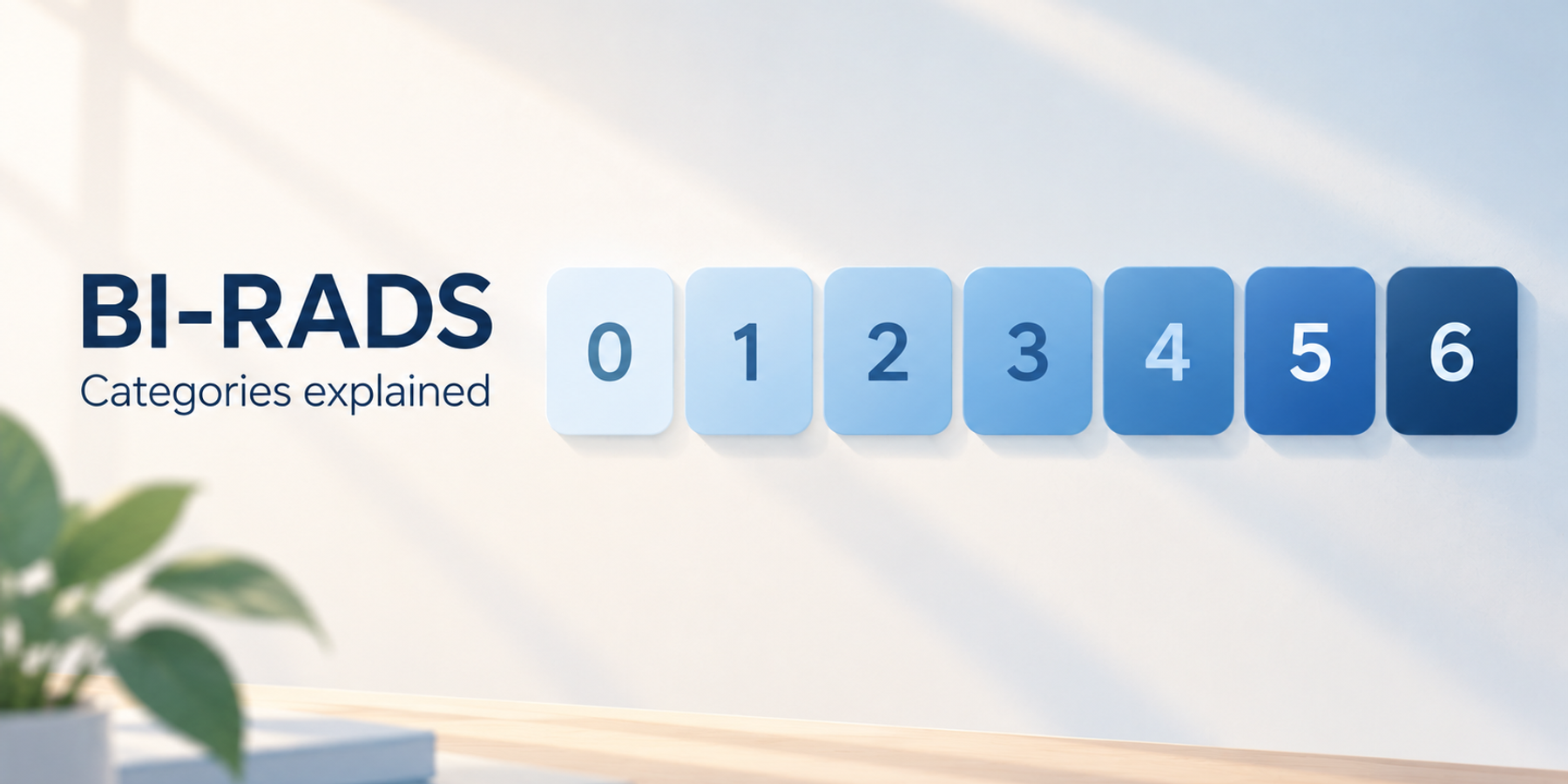
A BIRADS score on your mammogram is simply a standard way of summing up the result in a single number, and a low number is good news. Let us break it down. BIRADS stands for Breast Imaging Reporting and Data System. It is a category from 0 to 6 that tells you, and every doctor who reads the report, how likely a breast finding is to be harmless or to need more tests. The whole point of BIRADS is to make reports clear and consistent, so the same finding gets the same category anywhere. Most women's mammograms come back BIRADS 1 or 2, which mean normal or benign. Higher numbers do not mean cancer is confirmed; they simply mean a closer look is advised. On your report, a BIRADS category is a standardised summary, not a diagnosis. What it means for you is for your doctor to explain.
If a mammogram report just landed on your WhatsApp and a BIRADS number is making you anxious, slow down, because most scores are reassuring. This guide explains what each category means, from 0 to 6, and what to ask your doctor. And if the rest of the report reads like another language, FlexReport can help. Upload it on app.flexreport.ai and get a plain-language version in minutes.
What does BIRADS mean on a mammogram?
BIRADS is a scoring system that radiologists use to summarise a mammogram, breast ultrasound or breast MRI in one clear category. Rather than leave you guessing what a report means, BIRADS translates the findings into a number from 0 to 6, each with a defined meaning and a recommended next step. This standardisation is genuinely helpful: it means a category 2 in one clinic means the same as a category 2 in another, and doctors always know what follow-up each score suggests (Radiological Society of North America). Importantly, BIRADS grades the level of concern and the plan, not a diagnosis. A higher number tells your doctor to look more closely; it does not, by itself, confirm what a finding is.
BIRADS 0 to 6 in plain terms
Each BIRADS category has a plain meaning and a usual next step, and seeing them together takes the fear out of the number. The lower categories are the common, reassuring ones. The middle category, BIRADS 3, means probably benign and usually just calls for a short-interval follow-up. The higher categories mean a finding looks more suspicious and a biopsy is advised to be sure, though many of those still turn out benign. The table below lays them out.
| BIRADS | In plain terms | Usual next step |
|---|---|---|
| 0 | Incomplete, more images needed | Extra views or an ultrasound to complete the assessment. |
| 1 | Normal | Routine screening as usual. Nothing found. |
| 2 | Benign | Routine screening. A definitely harmless finding was seen. |
| 3 | Probably benign | A short-interval follow-up scan, often in 6 months. |
| 4 | Suspicious | A biopsy is usually recommended. Many still prove benign. |
| 5 | Highly suspicious | A biopsy is strongly recommended. |
| 6 | Known cancer | Used when cancer is already confirmed, to guide treatment. |
BIRADS sorts your result into a category with a clear next step. A low number is reassuring, and even a higher one is a plan, not a verdict.
What happens next after your BIRADS score?
What happens next is written into the category itself, which is the beauty of BIRADS. A 1 or 2 means simply carry on with routine screening. A 0 means the radiologist needs a few more images before deciding, which is common and not a worry. A 3 usually means a follow-up scan after about six months to confirm a probably-benign finding stays stable. A 4 or 5 means a biopsy is advised to get a definite answer, and it is worth remembering that many biopsies for BIRADS 4 findings come back benign. A 6 is used only when cancer is already confirmed, to guide treatment. Your doctor will walk you through the exact next step for your score, so you are never navigating it alone.
A few useful questions to carry into your appointment:
- What is my BIRADS category, and what does it mean for me?
- What is the exact next step, and when should it happen?
- If a biopsy is advised, what does it involve?
FlexReport is a patient comprehension layer for diagnostic centers, labs, and hospitals. It adds a plain-language second view to clinical reports without altering the clinical report itself. FlexReport operates in India and is built by FlexRad, a unified radiology platform with DICOM and PACS infrastructure across India and the US.