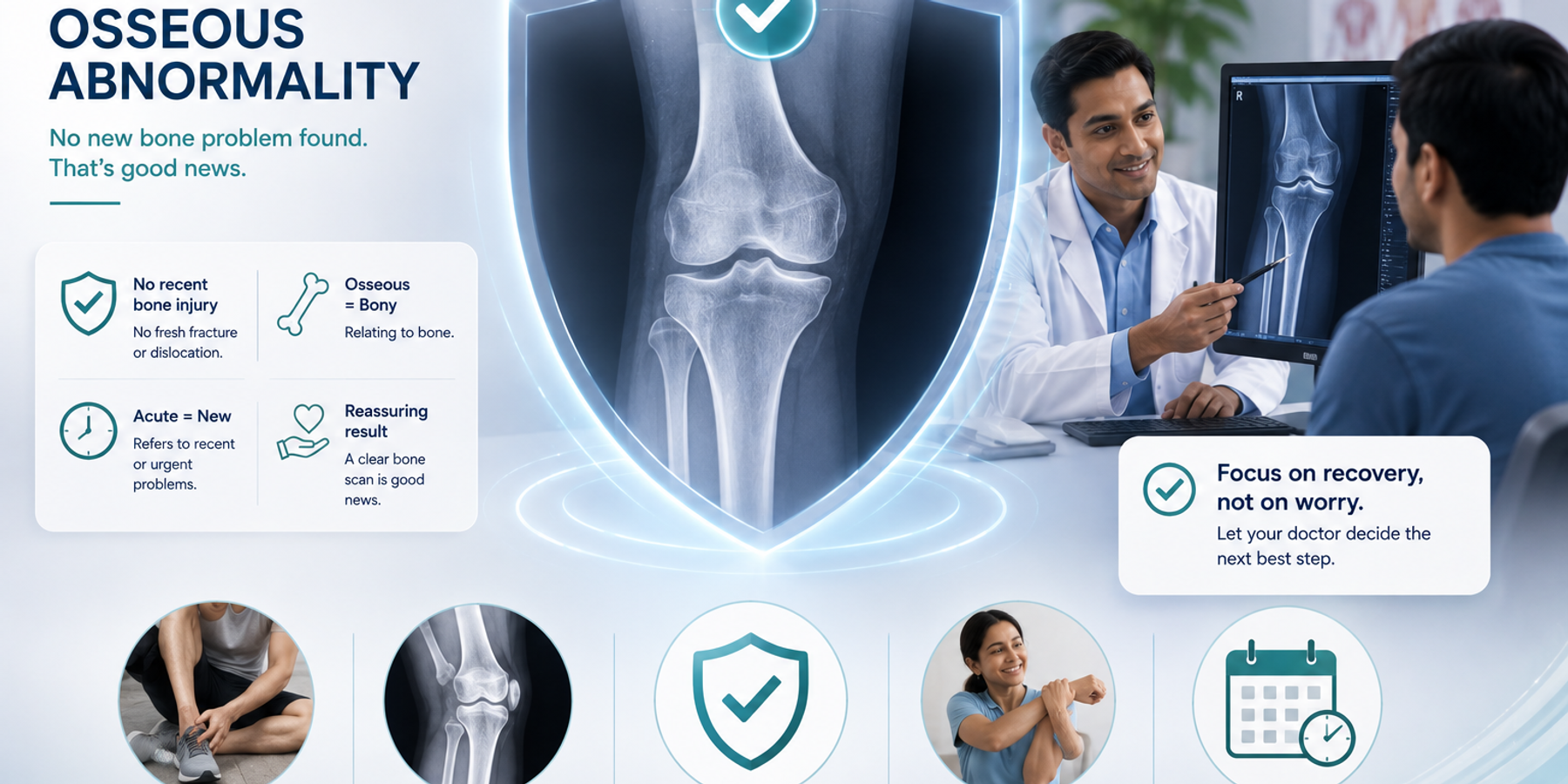
If your report says "no acute osseous abnormality", take a breath, because this is one of the most reassuring phrases a radiologist can write. It means no recent or urgent bone problem, such as a fresh fracture, was seen on the scan. Let us break it apart word by word. No means none. Acute means recent or new, not a long-standing change. Osseous means bony, or relating to bone. Abnormality means something that looks out of the ordinary. Put together, the phrase says: no new bone problem was found. It is the sentence you want to see after an X-ray for a knock, a fall or a sprain, because it usually means nothing is broken. It describes the absence of a fresh bone injury, which is a finding, not a diagnosis of any condition. On your report, it is the radiologist telling you what they did not find, and in this case that is good news.
If this phrase turned up on a report on your WhatsApp and the long words made you nervous, relax, because it is reassurance dressed up in medical language. This guide explains exactly what it means, what it does and does not rule out, and when to still see your doctor. And if the rest of the report reads like another language, FlexReport can help. Upload it on app.flexreport.ai and get a simplified, plain-language version of the whole thing in minutes.
What does "no acute osseous abnormality" mean?
"No acute osseous abnormality" means the scan found no recent or urgent bone problem, most importantly no fresh fracture or dislocation. Radiologists, the specialist doctors who read scans, often phrase findings by what is not there, because ruling out a fresh injury is exactly what many scans are for. This phrase most commonly appears on X-rays done after an injury, a fall, or pain, where the main question is simply, is anything broken. When the answer is no, this is how they say it. The word acute is doing important work here: it tells you the scan is commenting on new problems, not on every possible old change. So a clear, reassuring bone result and this phrase go hand in hand. The table below breaks the phrase down word by word so it never has to feel like code again (Radiological Society of North America).
| Word | What it means |
|---|---|
| No | None. The finding was not seen. |
| Acute | Recent or new, such as a fresh fracture, rather than an old change. |
| Osseous | Bony, or relating to bone. |
| Abnormality | Something that looks out of the ordinary. |
| Whole phrase | No recent bone problem, such as a fracture, was seen on the scan. |
Why the word "acute" is the key
The word acute is the most important part of the phrase, because it defines exactly what the scan is and is not saying. Acute means recent or new. Its opposite, chronic, means long-standing. When a report says no acute osseous abnormality, it is confirming there is no fresh bone injury, but it is not promising that your bones are flawless in every way. You might, for example, still have mild age-related changes such as early arthritis, and if the radiologist sees those, they usually mention them separately, using words like degenerative or chronic. So the phrase is precise, not vague. It answers the urgent question, is anything newly broken, with a reassuring no, while leaving room to describe any older, non-urgent changes elsewhere in the report. Understanding this stops the phrase from sounding either too alarming or falsely absolute.
No acute osseous abnormality is the radiologist telling you what they did not find. In plain terms: nothing is freshly broken.
Related phrases you might see on the same report
Bone reports use a small family of phrases that all lean reassuring, and it helps to recognise them together. You may see no fracture or dislocation, which is simply a more specific version of the same good news. You may see soft tissues are unremarkable, meaning the muscles and other tissues around the bone looked normal too. If any older changes are present, you may see words like degenerative changes or chronic, which describe long-standing, non-urgent findings rather than new ones. And if the radiologist saw an area of bone worth describing but not an acute one, they might use osseous lesion or osseous abnormality, which are neutral words for an area of bone that looks different and are most often benign. The table translates the common ones.
| Phrase on the report | What it usually means |
|---|---|
| No fracture or dislocation | A more specific way of saying no fresh bone injury. Reassuring. |
| Soft tissues unremarkable | The muscles and tissues around the bone looked normal. |
| Degenerative changes / chronic | Old, long-standing changes such as mild arthritis. Not urgent. |
| Osseous lesion / osseous abnormality | A neutral term for an area of bone that looks different. Most are benign. |
One gentle note for the sons, daughters and spouses who often manage a family member's care, because in many Indian homes that is exactly who is reading this. After a fall in an older parent, a report saying no acute osseous abnormality is a big relief, and rightly so. But keep watching how they move and whether pain settles over the next few days, and do not hesitate to go back if it does not. In India that follow-up visit is usually possible the same day or the next, so it costs little to be sure.
What happens next after this finding?
After a report of no acute osseous abnormality, the next steps are usually simple and depend on why the scan was done. If it was an injury, your doctor will often treat it as a soft-tissue problem, such as a sprain or bruise, with rest, pain relief and time, since nothing is broken. If pain continues despite the reassuring bone result, your doctor may examine the area again or arrange a different test, such as an ultrasound or MRI, which show muscles, ligaments and soft tissues that an X-ray cannot. If any older changes were noted separately on the report, your doctor will explain whether they need anything, which often they do not. The key point is that this phrase closes off the most urgent worry, a fresh fracture, and lets your doctor focus on the actual cause of your symptoms.
A few useful questions to carry into your appointment:
- If nothing is broken, what is most likely causing my pain?
- Did the report mention any older or chronic changes I should know about?
- Should I have another test if the pain does not settle, and when?
Walking in with your questions written on your phone keeps a five-minute consult from ending before your doubts do.
FlexReport is a patient comprehension layer for diagnostic centers, labs, and hospitals. It adds a plain-language second view to clinical reports without altering the clinical report itself. FlexReport operates in India and is built by FlexRad, a unified radiology platform with DICOM and PACS infrastructure across India and the US.