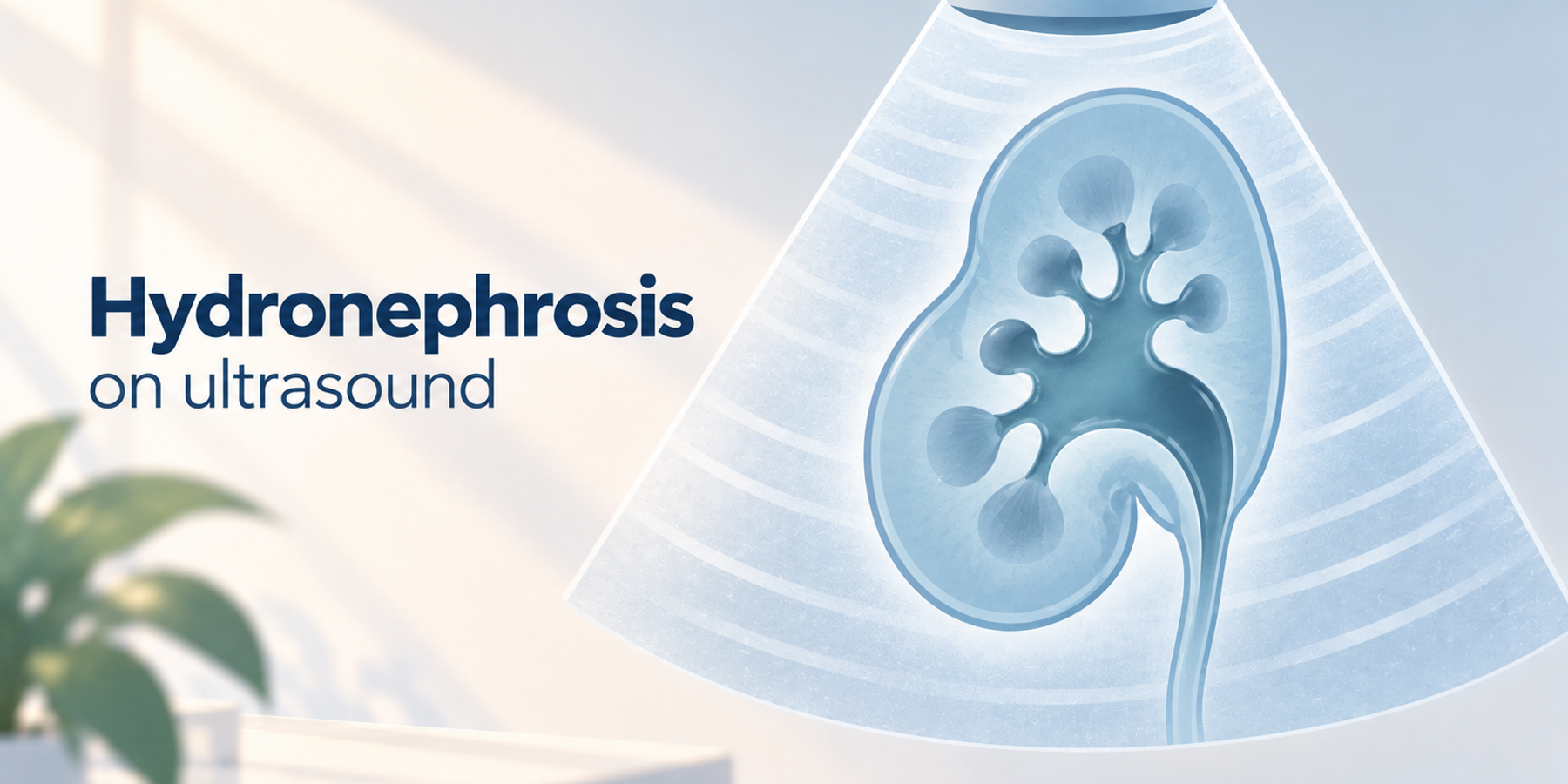
Hydronephrosis on your ultrasound simply means a kidney looks swollen because urine is backing up inside it, like a sink that is not draining freely. Let us break it down. The word comes from hydro, meaning water, and nephrosis, relating to the kidney, so hydronephrosis is a kidney swollen with urine. Normally, urine made by the kidney drains down a thin tube to the bladder. If that flow is partly blocked or slowed anywhere along the way, urine backs up and the kidney's collecting spaces widen, which the scan shows as swelling. The key idea is that hydronephrosis is a plumbing description, not a disease in itself, and it points your doctor to look for the cause of the hold-up. It ranges from mild to severe. On your report, hydronephrosis is a description of what the scan showed, not a diagnosis. What it means for you is for your doctor to judge, and it is worth seeing them reasonably promptly.
If hydronephrosis on a report has alarmed you, take a breath, because it often has a simple, treatable cause such as a small stone. This guide explains what it means, its grades, and what to ask your doctor. And if the rest of the report reads like another language, FlexReport can help. Upload it on app.flexreport.ai and get a plain-language version in minutes.
What does hydronephrosis mean?
Hydronephrosis means the urine-collecting spaces inside a kidney have widened because urine is not draining away as freely as it should. Ultrasound shows this clearly as an enlargement of those spaces, which radiologists often grade from mild to severe depending on how stretched they look (Radiological Society of North America). The important point is that hydronephrosis tells you there is a drainage issue, but not, by itself, what is causing it. The cause is what really matters, and finding it is the next step. Because a blocked kidney can be uncomfortable and, if a blockage persists, can affect kidney function over time, hydronephrosis is a finding your doctor will want to act on reasonably promptly, even though the cause is frequently something as treatable as a small kidney stone.
Grades and common causes
Hydronephrosis is usually described as mild, moderate or severe, which reflects how much the collecting spaces have stretched, not automatically how serious the cause is. A mild grade is often minor and may even be picked up by chance. The cause matters more than the grade, and the common causes are frequently treatable. A kidney stone temporarily blocking the drainage tube is one of the most frequent reasons. Other causes include a narrowing of the tube, or in men an enlarged prostate slowing bladder emptying. The table below sets out the grades and typical causes so you can read your report with less fear, though your doctor makes the actual assessment.
| Grade or cause | What it usually means |
|---|---|
| Mild hydronephrosis | Slight swelling. Often minor, sometimes found by chance. |
| Moderate to severe | More swelling. The cause and kidney drainage are assessed promptly. |
| Kidney stone | A very common, often treatable cause of a temporary blockage. |
| Narrowed drainage tube | A cause of slower flow, managed by a specialist. |
| Enlarged prostate (in men) | Can slow bladder emptying and back up the flow. |
Hydronephrosis is a plumbing description, not a disease. The cause, often a simple stone, is what your doctor really needs to find.
What happens next after this finding?
What happens next centres on finding and treating the cause. Your doctor will usually look for the reason the flow is backing up, often with a further scan such as a CT to spot a stone, and blood or urine tests to check the kidney. If a small stone is the cause, it frequently passes on its own with fluids and pain relief, and the swelling then settles. If a blockage persists or the kidney is at risk, a specialist may relieve it with a small procedure. In men, treating an enlarged prostate can resolve the backup. A repeat scan is often done to confirm the kidney has returned to normal. The reassuring theme is that hydronephrosis usually has a findable, treatable cause, which is exactly what your doctor sets out to address.
A few useful questions to carry into your appointment:
- What grade is my hydronephrosis, and what is likely causing it?
- What test do we need to find the cause, and how soon?
- Which symptoms mean I should seek care urgently?
FlexReport is a patient comprehension layer for diagnostic centers, labs, and hospitals. It adds a plain-language second view to clinical reports without altering the clinical report itself. FlexReport operates in India and is built by FlexRad, a unified radiology platform with DICOM and PACS infrastructure across India and the US.