You got your blood test report on WhatsApp an hour ago. You opened it, saw words like SGPT, a number in bold, maybe an H or an arrow next to it, and your stomach dropped. That feeling has a cost, and you do not have to carry it alone. This page is about getting your blood test report explained online, in plain language, so you walk into your doctor's clinic calm and with the right questions, instead of scared and Googling at midnight.
Here is the short version. FlexReport lets you upload your blood test report and gives you a simple, plain-English second view of it. It tells you which values are normal, which ones are flagged, what each term actually means in everyday words, and what to ask your doctor. It does not diagnose you and it does not replace your doctor. It just makes the report readable. You can try it with one report right now. Pay per report from ₹49, no subscription.
We know how it works here. Nobody in India waits five days for an appointment just to understand a report. You get the WhatsApp PDF from the lab, and within a couple of hours you have either forwarded it to the family group or walked into the next clinic in your gali for a second opinion. That is completely normal. The problem is, you are making those decisions while panicking over a word you cannot read. FlexReport's job is to take the panic out of that two-hour window.
What does getting your blood test report explained online actually mean?
Getting your blood test report explained online means uploading the report you already received, usually a PDF or a photo from your lab, and getting back a plain-language version any normal person can read. A blood test report is a list of measurements taken from a small sample of your blood, each shown next to a reference range, which is simply the band of values considered typical for most healthy people. When your value sits outside that band, the lab marks it, often with an H for high or an L for low. The report gives you the numbers. It almost never tells you what they mean. That gap is exactly what an online explainer fills. FlexReport reads the same report your doctor reads, keeps the original untouched, and adds a second view in everyday words. It is a description, not a diagnosis.
Think of it like subtitles for your report. The original audio, your lab's clinical report, does not change at all. You just get a track underneath it that you can actually follow.
Why your blood test report feels like it is written in another language
Your report feels unreadable because it is written for clinicians, not for you. Labs use short codes and Latin-rooted medical terms because that is the professional shorthand doctors are trained in. So you get SGPT, ALP, Hb, and TSH with no full forms and no explanation, sitting next to numbers and ranges. None of it is meant to be unkind. It just was never designed for the person whose blood it is. The result is predictable. You fix on one scary-looking value, ignore the twenty normal ones, and your mind jumps to the worst possibility.
This is where the Indian reality bites harder. In many countries the patient gets the report inside a consultation, with a doctor across the table to explain it. Here, the lab sends it straight to your phone, often before you have seen anyone. So you are alone with it. And because a second opinion is cheap and ten minutes away, the natural move is to rush to another clinic or flood the family WhatsApp group with the PDF, where a worried relative forwards you something even more frightening. None of that helps you understand the actual report.
Your report tells you the numbers. It almost never tells you what they mean.
A real example: an LFT (Liver Function Test) report, before and after
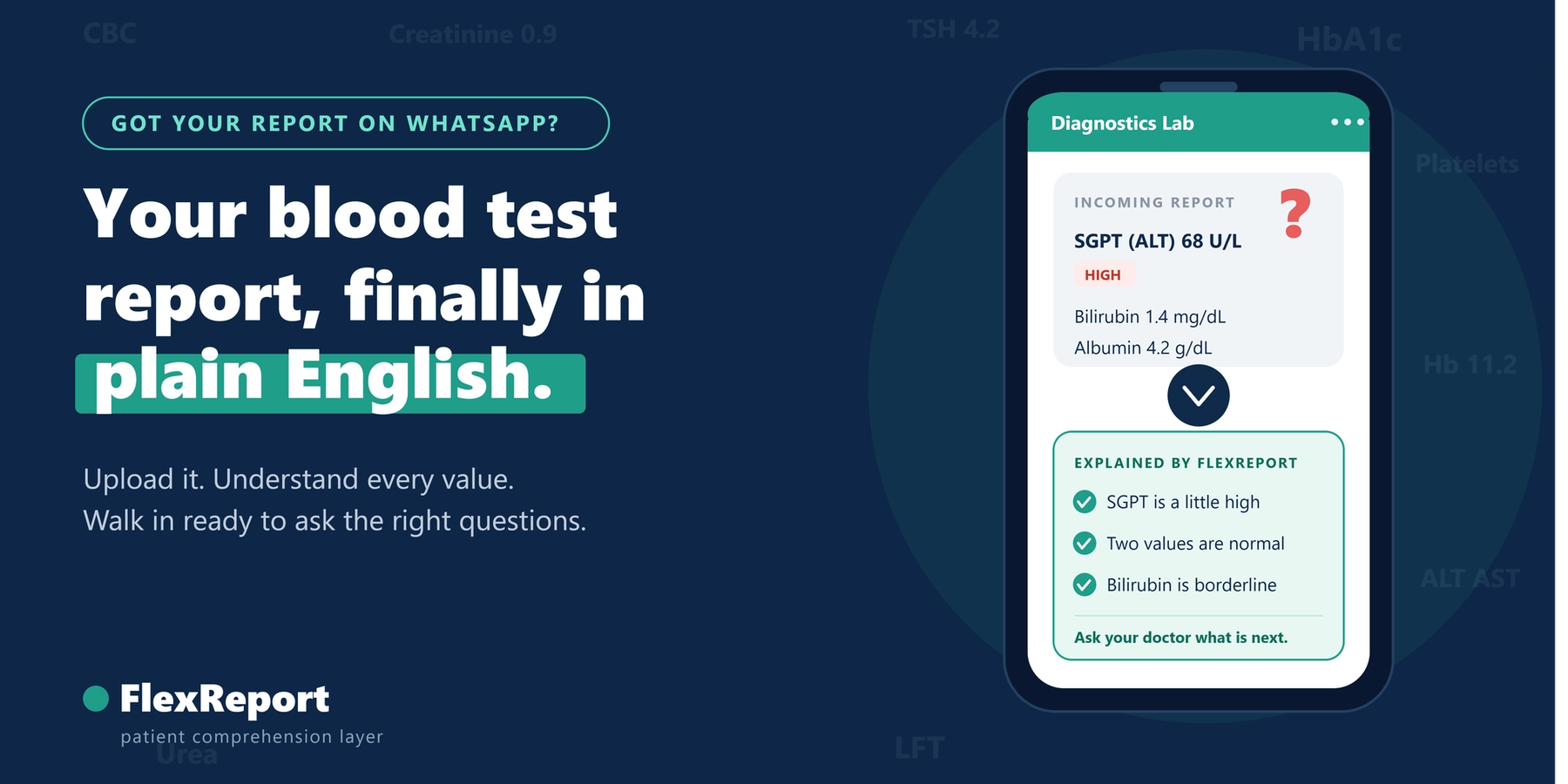
Here is what the confusion looks like, and what FlexReport turns it into. An LFT, or Liver Function Test, is a group of blood tests that check how your liver is working by measuring certain enzymes and proteins your liver makes or processes. On a raw report, an LFT looks like a wall of codes and numbers with no meaning attached. Most people fix on the one value with an H next to it and assume the worst. The point of the before-and-after below is simple: the same data, made readable.
Before: what the lab sends you
| Test | Result | Reference range |
|---|---|---|
| Bilirubin (Total) | 1.4 mg/dL | 0.3 to 1.2 |
| SGPT (ALT) | 68 U/L (High) | 7 to 56 |
| SGOT (AST) | 45 U/L | 5 to 40 |
| ALP | 110 U/L | 44 to 147 |
| Albumin | 4.2 g/dL | 3.5 to 5.0 |
After: what FlexReport's plain-English view says
- Bilirubin (Total): slightly above the usual range. Bilirubin is a yellow pigment your body makes when old red blood cells are broken down, and the liver normally clears it. A mildly raised level typically refers to the liver clearing it a little slower than usual. It is a description, not a diagnosis, and many ordinary things can nudge it up.
- SGPT, also written as ALT (Alanine Aminotransferase): above the usual range. SGPT is an enzyme found mostly inside liver cells. When it shows up higher in the blood, it typically refers to the liver being a little irritated or stressed. This is the value most people panic about, but on its own it is a flag to discuss, not a verdict.
- SGOT, also written as AST (Aspartate Aminotransferase): within the usual range. SGOT is a related liver enzyme, and yours sits inside the normal band, which is reassuring context next to the SGPT above.
- ALP (Alkaline Phosphatase): normal. ALP is an enzyme linked to your liver and bones, and yours is in range.
- Albumin: normal. Albumin is a protein your liver makes, and a normal level usually points to the liver doing this particular job fine.
See the difference. The raw report gave you one scary H and four mysteries. The plain-English view tells you that one value is mildly up, one is up, two are perfectly fine, and exactly what each word means. It then hands you the right question to carry to your doctor: my SGPT is a little high and my bilirubin is borderline, what could be causing that, and do I need a repeat test? That is a calm patient walking in, not a frightened one.
How FlexReport explains your blood test report, step by step
FlexReport works in three plain steps, and the whole thing takes minutes, not days. First, you upload your report, the same PDF or photo your lab sent to your phone. Second, FlexReport's Engine reads it and produces a plain-language second view: it lists every test, marks which values are inside the usual range and which are flagged, and spells out what each term means in everyday words, with the full form written out. Third, it gives you a short, sensible list of questions to ask your doctor, built around whatever was actually flagged in your report. The original clinical report is never changed. Your doctor remains the source of truth.
- Upload. Send in the PDF or photo of the report your lab already gave you.
- Read it in plain English. FlexReport's Engine flags every value and explains each term in everyday words.
- Walk in prepared. You get a short list of questions to ask your doctor, based on what was flagged.
What you will not get is a diagnosis, a treatment plan, or a scary you have X sentence. That is not what this is. FlexReport stays firmly on the comprehension side. It explains, it does not decide. The decision is your doctor's, and the explainer simply means you reach that conversation already understanding what is on the page.
Which blood tests can FlexReport explain?
FlexReport can explain the common blood tests that Indian labs run every day, the ones that fill up most reports and cause most of the confusion. These are not exotic tests. They are the everyday panels your doctor orders for a fever, a checkup, tiredness, or a routine company health camp. Each one gets the same treatment: the full form spelled out, what it checks in plain words, and whether your values are flagged. Here are the ones people most often need explained.
- CBC (Complete Blood Count): the basic count of your blood cells. It includes Hb (Haemoglobin), which carries oxygen and is the value linked to anaemia, plus WBC (White Blood Cells), which fight infection, and Platelets, which help blood clot.
- LFT (Liver Function Test): how your liver is working, covered in the example above.
- KFT or RFT (Kidney Function Test, also called Renal Function Test): how your kidneys are doing, using values like Creatinine and Urea.
- Lipid Profile: your cholesterol panel. LDL (Low Density Lipoprotein) is the bad cholesterol, HDL (High Density Lipoprotein) is the good one, plus Triglycerides, a type of fat in the blood.
- HbA1c (Glycated Haemoglobin): your average blood sugar over roughly the last three months, the key diabetes number.
- TSH (Thyroid Stimulating Hormone): the main signal that shows how your thyroid is functioning.
If your report has a test that is not on this list, upload it anyway. The explainer covers far more than these six.
Is it safe to upload my report?
This is the right question to ask, and the honest answer is that your report is sensitive and should be treated that way. A blood test report is personal health information, and how a service handles it matters more than any feature. FlexReport uses your report only to generate your plain-language explanation. It is not sold, and it is not handed to advertisers or other third parties. If you are going to share the report on a family WhatsApp group anyway, which most of us do, getting a clean readable version first is the safer habit. You forward understanding, not panic.
Does this replace my doctor?
No, and it is not meant to. The explanation is built to be accurate as a plain-language description of your report, not as a diagnosis. FlexReport tells you what each term means and whether a value is flagged. It does not tell you what condition you have or what to do about it. That line matters, because a number outside the usual range can have many ordinary explanations, and only your doctor, who knows your history, symptoms, and full picture, can say what it means for you specifically. The clinical report your lab issued is the official record. FlexReport adds a readable layer on top of it and changes nothing in the original.
So use it the way it is designed. Read your report in plain English, understand which values are flagged, note the questions worth asking, and take all of that to your doctor, whether that is your regular physician or the clinic down the road you are about to walk into. You will get more out of that visit because you are not starting from zero.
FlexReport is a patient comprehension layer for diagnostic centres, labs, and hospitals. It adds a plain-language second view to clinical reports without altering the clinical report itself. FlexReport operates in India and is built by FlexRad, a unified radiology platform with DICOM and PACS infrastructure across India and the US.