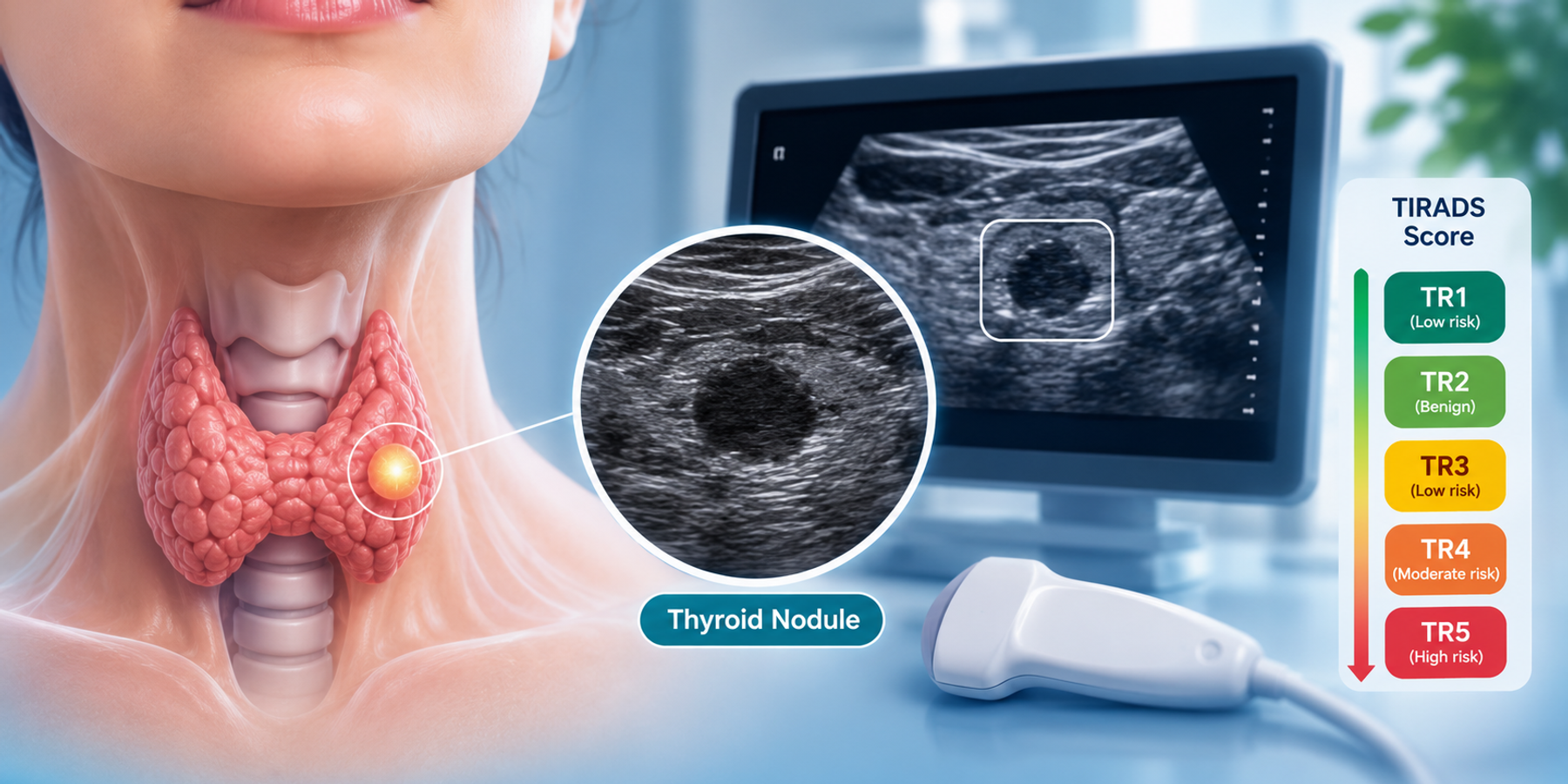
A thyroid nodule on your ultrasound simply means the scan found a small lump in your thyroid gland, and the large majority of these are harmless. Let us break it down. The thyroid is a small butterfly-shaped gland in the front of your neck that helps control your energy and metabolism. A nodule is just a lump or growth, and finding one is extremely common, especially as we get older. Most thyroid nodules are benign, meaning non-cancerous, and many are found by chance during a scan done for something else. To decide whether a nodule needs more attention, radiologists often give it a TIRADS score, which grades how suspicious it looks on the scan. On your report, a thyroid nodule and its TIRADS score are a description of what the scan showed, not a diagnosis. What it means for you is for your doctor to judge using the whole picture.
If a neck ultrasound report just landed on your WhatsApp and words like nodule or TIRADS are worrying you, slow down. This guide explains what the finding means, what the score tells you, and what to ask your doctor. And if the rest of the report reads like another language, FlexReport can help. Upload it on app.flexreport.ai and get a plain-language version in minutes.
What is a thyroid nodule on ultrasound?
A thyroid nodule on ultrasound is a lump within the thyroid gland that the scan has found and measured. Ultrasound is the main way nodules are studied because it is safe, painless and uses no radiation. Nodules can be solid, fluid-filled like a cyst, or a mix of both, and this appearance matters. A nodule that is mostly clear fluid is almost always harmless, while a solid nodule with certain features is looked at more carefully. Radiologists, the specialist doctors who read scans, note every nodule they see, including tiny ones that cause nothing, because describing everything is their job (Radiological Society of North America). The report usually gives the size, whether the nodule is solid or cystic, and often a TIRADS score to summarise how suspicious it looks.
TIRADS in plain terms
TIRADS stands for Thyroid Imaging Reporting and Data System. It is a score from TR1 to TR5 that grades how suspicious a nodule looks on ultrasound, a bit like a risk shelf from very low to higher concern. A lower score is reassuring and usually means little or no follow-up, while a higher score is more likely to prompt a simple needle test to be sure. The important thing to hold on to is that TIRADS is a way of sorting nodules, not a diagnosis by itself. A higher number means a closer look, not a confirmed problem. The plain-language version is below.
| TIRADS score | In plain terms | What it usually means |
|---|---|---|
| TR1 | Benign | Reassuring. No follow-up needed. |
| TR2 | Not suspicious | Considered benign. Usually no biopsy. |
| TR3 | Mildly suspicious | Low risk. May be watched or biopsied if larger. |
| TR4 | Moderately suspicious | May need a needle test depending on size. |
| TR5 | More suspicious | More likely to need a biopsy for a clear answer. |
TIRADS grades how a nodule looks, not what it is. A higher number means a closer look, not a diagnosis.
Is a thyroid nodule serious? Is it cancer?
The large majority of thyroid nodules are not serious and are not cancer. Most are benign, and even many that get a needle test turn out to be harmless. Only a small share are thyroid cancer, and when caught, thyroid cancer is often very treatable. This is why doctors take nodules seriously enough to check the suspicious ones, without treating every nodule as a threat. What matters is the full clinical picture: the nodule's features and TIRADS score, its size, whether it is growing, and your thyroid blood tests. Assembling that picture is your doctor's job, not a search engine's. A report line is one puzzle piece. Your doctor holds the whole puzzle.
What happens next after this finding?
What happens next depends on the nodule's TIRADS score and size, plus your thyroid blood tests, and for most people it is low-key. For a low-score or small nodule, doctors often simply watch it with a repeat ultrasound after some months. For a higher-score or larger nodule, the usual next step is a fine needle aspiration, often shortened to FNAC, where a very thin needle takes a tiny sample to check the cells. It is a quick outpatient test, not surgery. Your doctor may also check your thyroid hormone levels with a blood test, since some nodules affect them. Follow-up scans are a normal way of keeping watch, not a sign that something bad has been found.
A few useful questions to carry into your appointment:
- What is my nodule's TIRADS score and size?
- Do I need a needle test, or can we watch it?
- Are my thyroid blood tests normal, and when should I have a repeat scan?
FlexReport is a patient comprehension layer for diagnostic centers, labs, and hospitals. It adds a plain-language second view to clinical reports without altering the clinical report itself. FlexReport operates in India and is built by FlexRad, a unified radiology platform with DICOM and PACS infrastructure across India and the US.